Possible applications of Systec autoclaves Sterilization of liquids
When sterilizing liquids, special time, temperature and pressure requirements must be taken into account. While the actual sterilization time is usually only a small part of the overall cycle, the heating and cooling phases take up the largest part of the process time.
Systec autoclaves are designed in such a way that these phases can be considerably shortened through targeted control of pressure and temperature. This leads to shorter batch times, greater safety and reproducible results.
Heating up
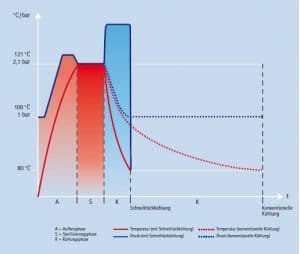
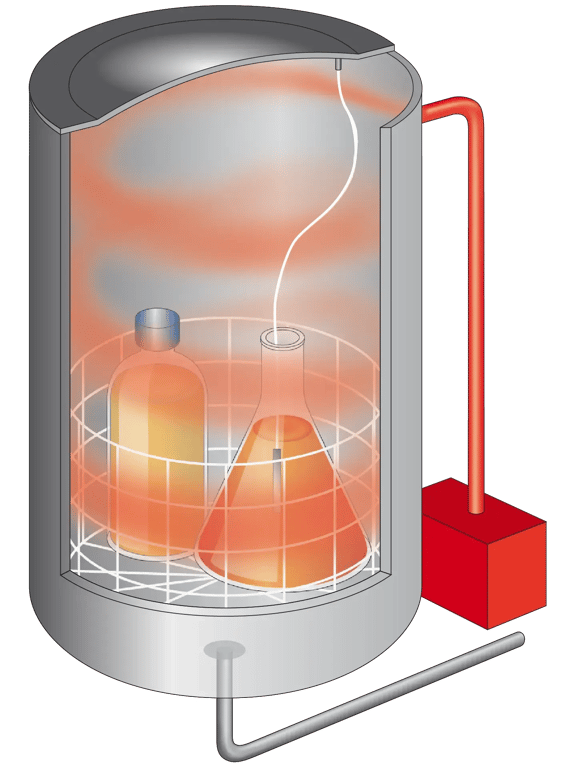
In conventional systems, the fluid temperature is usually significantly lower when the planned internal chamber temperature is reached, often only between 60 °C and 90 °C. This is because the fluid heats up more slowly than the chamber air. The reason for this is that the liquid heats up more slowly than the chamber air. The temperature equalization time is therefore considerably longer, which means that the entire heating phase is significantly longer.
Up to 50% shorter heat-up time as standard: The combined control of pressure and temperature increases the chamber pressure during the heat-up phase. This allows the temperature of the liquid to be equalized more quickly with a shorter heating time.
Cooling
The cooling process of liquids is also very slow. This is because heat below 100°C can only be dissipated to the environment via convection to a very limited extent due to the insulation and without active cooling. This is possible as long as active rapid recooling is not possible (see illustration).
However, thanks to the latest system and process technologies, the entire batch time can be significantly shortened, reducing the overall duration of the process by several hours. In addition, the media are not exposed to increased temperatures for an unnecessarily long time.
To enable precise sterilization processes, safe handling and ultimately increased productivity, Systec autoclaves offer a wide range of functions for liquid sterilization. Many of these are already integrated as standard or can be added as an option.
Systec autoclaves shorten the recooling phase thanks to various active systems:
- Jacket cooling with cooling water
-
Jacket cooling with support pressure (steam-air mixture)
- Spray cooling with recooled sterile water
- Centrifugal fan and ultracooler (depending on model)
Jacket cooling with support pressure
During the cooling phase, sterile compressed air is used as support pressure to prevent the media from boiling. This means that hermetically sealed bottles remain intact and there is no boiling delay or loss of liquid.
A flexible PT 100 temperature sensor permanently monitors the temperature in the reference vessel.
The sterilization time only starts when the liquid temperature is reached. The lid only opens at ≤ 80 °C in accordance with the standard.
Advantages:
-
No loss of liquid or boiling over
- No risk of bursting or boiling delay
- Up to 60 % shorter recooling time
- No recontamination
-
Full utilization of the filling volume
- Higher productivity thanks to shorter cycles
Centrifugal fan
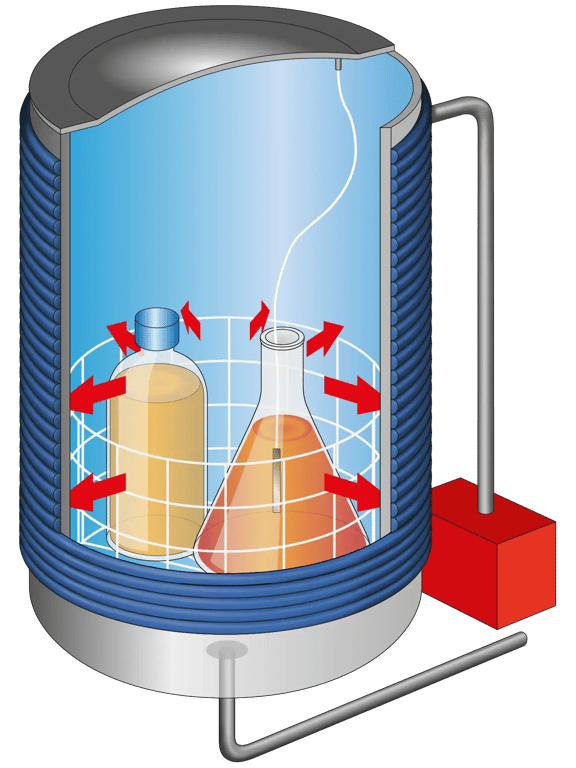
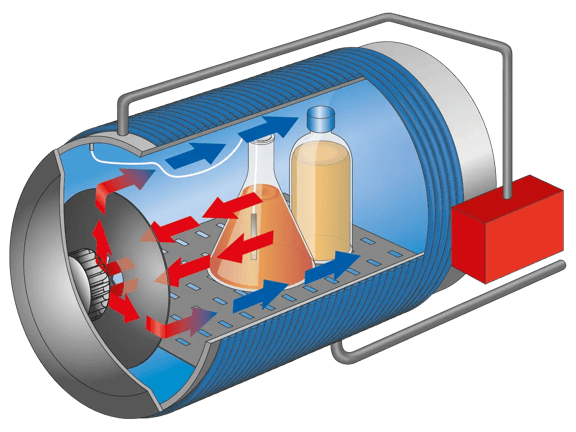
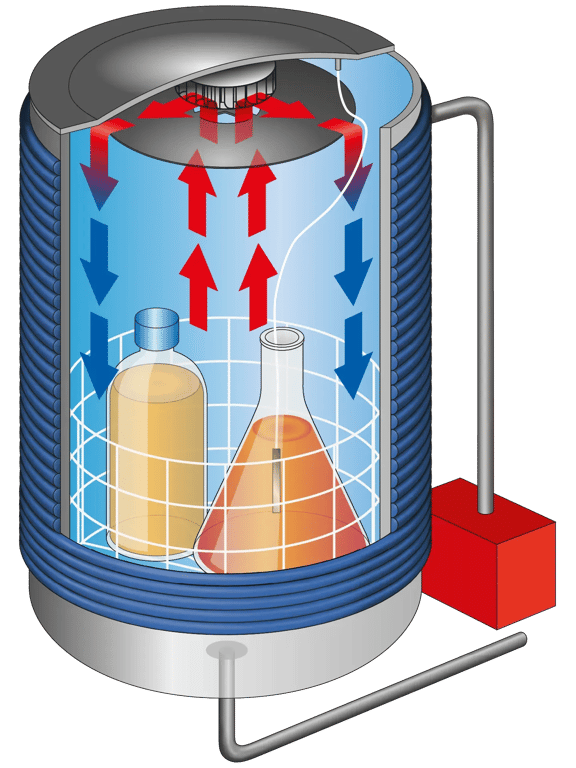
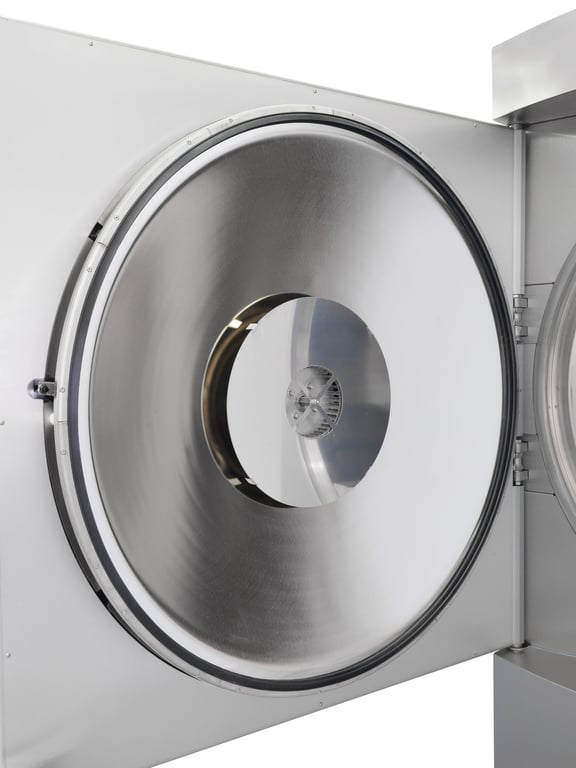
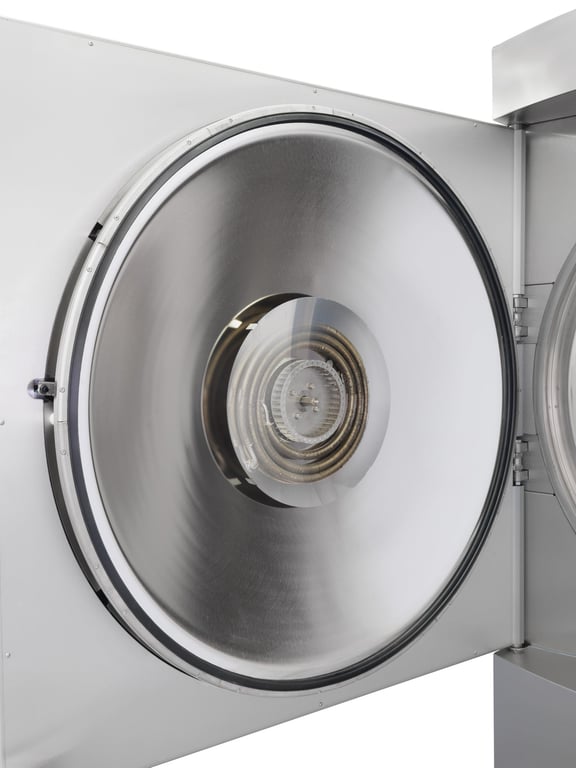
In conjunction with the optional jacket cooling, the radial fan ensures accelerated heat transfer from the sterilized items to the cooled sterilization chamber by circulating the air. The fan wheel is driven by the externally mounted motor via a magnetic coupling.
-
Air flow rate: 71 m³/h (VX, DX) or 250 m³/h (HX)
- Recooling time: reduced by up to 70
- Sufficient usable space thanks to integration in chamber door
Ultracooler
The Ultracooler is an additional heat exchanger that further increases the cooling capacity. In combination with jacket cooling and a support pressure system, it achieves recooling times of between 15 and 60 minutes - depending on the load and filling volume.
-
Full loading due to sufficient usable space
- Cooling times between 15 and 60 minutes possible - depending on load
- Recooling time reduced by up to 90
Secure processes for every application
We help you to tailor the process, equipment and documentation precisely to your application.