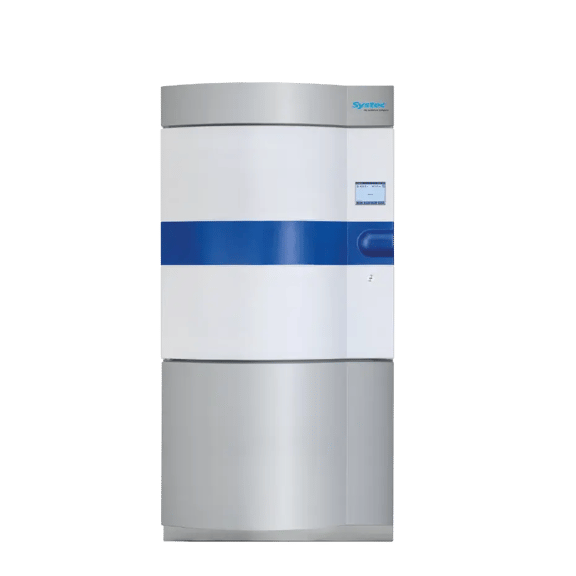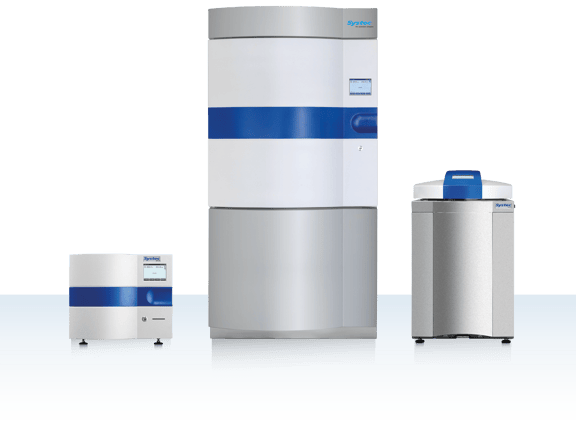
Product overview: Laboratory autoclaves and industrial autoclaves from the Systec brand

Systec autoclaves Laboratory and industrial autoclaves

Our autoclaves have proven themselves for over 30 years in research as well as in the pharmaceutical and food industries. Whether liquids, solids or waste: they reliably master demanding sterilization processes.
Request product Download brochure
Laborantin Systec Autoklaven

Standard features

Systec laboratory autoclaves: Steam generator

Steam generator

Integrated and separated from the chamber
Autoclaves with internal heating elements

Internal heating elements

in the chamber of the autoclave
Temperature and pressure in the Systec autoclave

Temperature and pressure range

140 °C, 4 bar absolute pressure
Autoclaves with timer

Timer

for programmable start time
Systec Autofill: Automatic water feed for steam generation in laboratory autoclaves

Autofill

Automatic demineralized water feed for steam generation
Autoclaves with RS-232 interface for data transfer

RS-232 interface

for external data transmission (network-compatible)
Autoclaves made from high-quality stainless steel

Stainless steel components

Housing, support frame and pressure vessel made of corrosion-resistant stainless steel
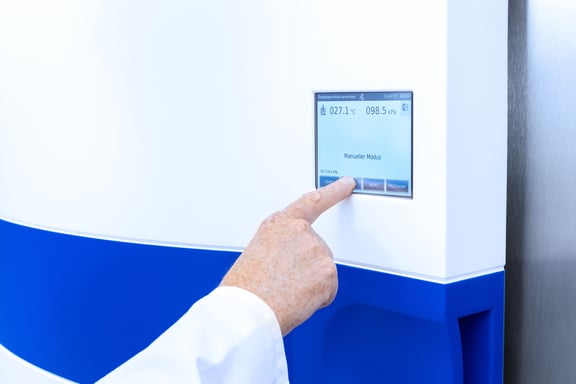
Touch display for intuitive operation

Touch screen

Controlling the devices with a touch screen
Large selection of programmes

Several sterilization programs

Up to 100 freely configurable sterilization programs
Systec media preparators: Personalised user profiles for safe device control

User account control

In the standard user account control, three preset and fixed groups are available, each with one user (Administrator, Operator, Supervisor)
Autoclave features: Batch information as free text input

Free text input

Free texts can be entered for batch information

Systec Connect Software: Internal storage of process data

Internal memory

Internal memory for backing up process data for at least 10 years

Systec Connect network connection via Ethernet interface

Ethernet

Ethernet network connection of the devices

Systec autoclaves with time synchronisation

Time synchronization

Time synchronization with time server via network or Internet

Autoclaves with F0 value calculation

F0 value calculation

Text missing

Autoclaves with special programmes

Special programs

Special programs for destruction sterilization with fractionated heating for efficient deaeration and for Dürham tubes

Systec autoclaves with high-precision temperature sensors

Temperature sensors

Flexible PT-100 class A temperature sensor and additional temperature sensor in the condensate outlet

Autoclave with validation port for external sensors

Validation port

Validation port for bringing in external measuring equipment

Systec waste water temperature control: Water-cooled and thermostatically controlled for laboratory autoclaves

Waste water temperature control

Water-cooled and thermostatically controlled

The right choice for your requirements

All products also available in stainless steel

Systec DX/VX-Series

For complex sterilization processes with maximum configuration and optimization options.
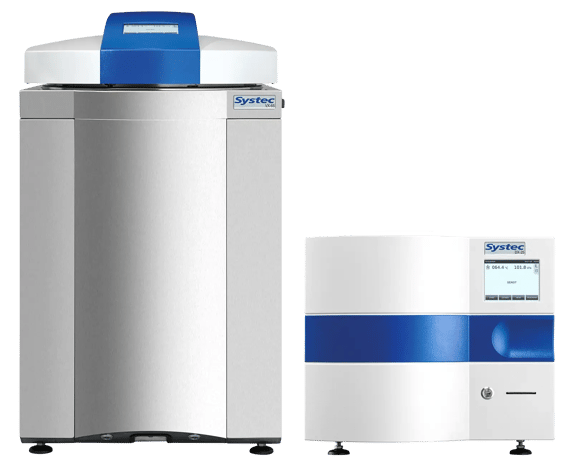
Systec autoclaves - DX and VX series for complex sterilisation processes

Systec DE/VE-Series

For simple laboratory applications with a reduced range of functions and a clear operating structure.
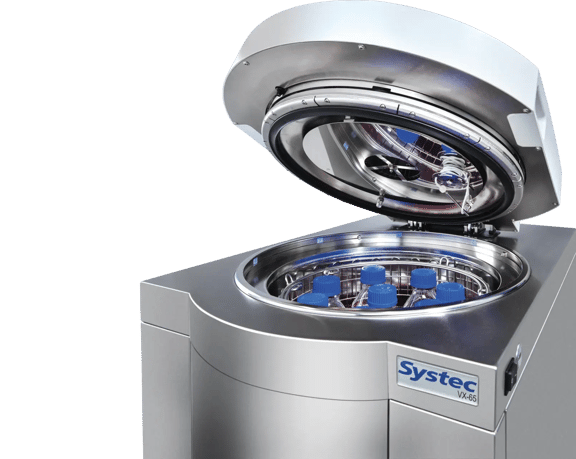
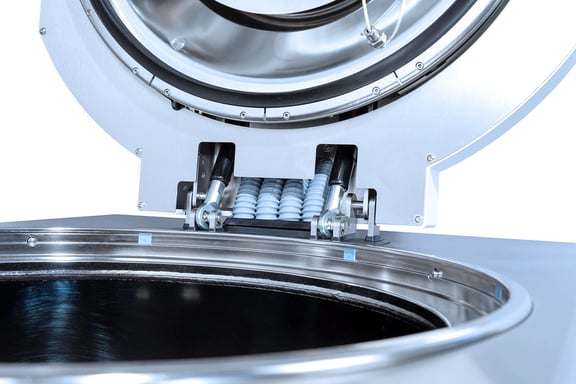
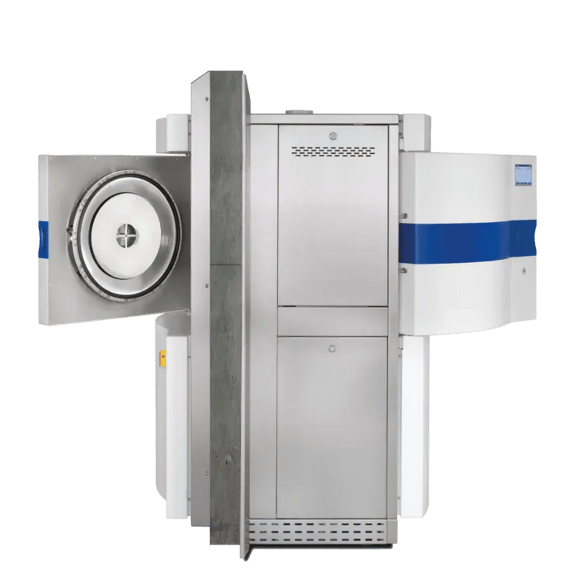
Opened vertical floor-standing autoclave from the Systec VE series
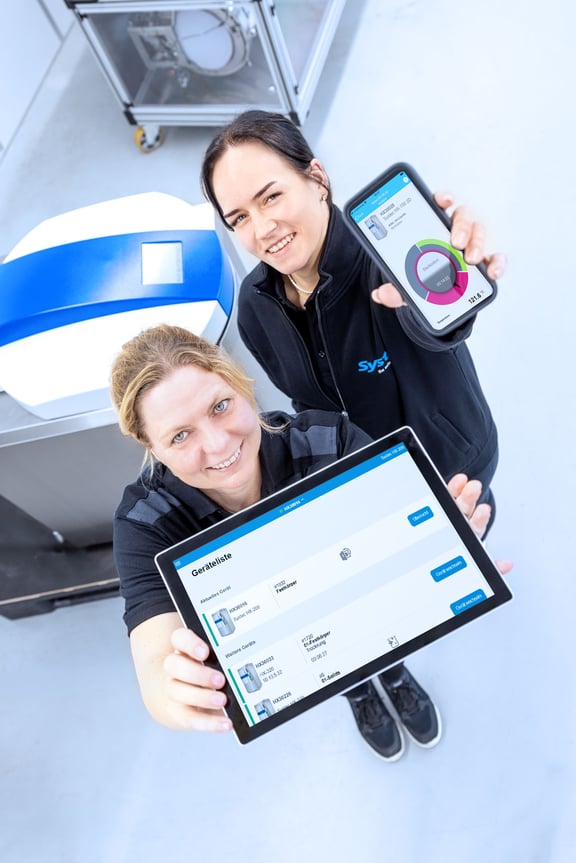
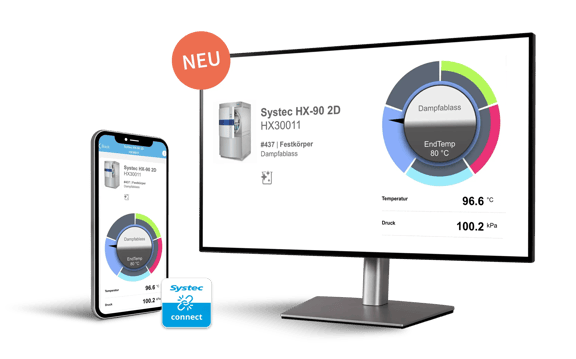
Systec Connect software: autoclave monitoring on smartphone, tablet and PC

Systec
Connect

Keep an eye on your autoclaves and monitor program progress in real time.

Why you should choose autoclaves from Systec

Possible applications

Sterilisation of liquids in an autoclave

Efficient sterilization of liquids

Rapid re-cooling systems such as jacket cooling, radial fans or ultracoolers reduce batch times by up to 90 % - with maximum product safety. No overcooking, no loss of liquid, no compromises.
More about how it works
Sterilization of solids

Sterilization of solids

Vacuum device and Superdry ensure complete deaeration and efficient drying of solids, textiles and porous materials. The fractionated pre-vacuum enables validatable sterilization, while Superdry eliminates the need for post-drying - for perfectly dried sterilized items in a single step.
More about how it works
Sterilization of waste in destruction bags

Sterilization of waste in destruction bags

The vacuum device removes air from waste bags using a fractionated pre-vacuum in combination with the steam generator. This allows the steam to penetrate completely into the items to be sterilized - for safe, reproducible and validatable sterilization of waste in destruction pouches.
More about how it works
Sterilization of biohazardous substances

Sterilization of biohazardous substances

Systec autoclaves can be equipped with exhaust air filtration for the sterilization of biohazardous substances. A PTFE filter cartridge (0.2 µm) is automatically sterilized inline during each process. At the same time, the condensate in the pressure vessel is safely sterilized so that no germs or hazardous substances are released into the environment - for maximum safety during every sterilization process.

More about how it works

Standards and guidelines

Systec autoclaves comply with the following and other standards and regulations:

Pressure vessel

  • 2014/68/EU Pressure Equipment Directive
  • ASME Boiler & Pressure Vessel Code, Section VIII, Division 1
  • China Stamp
  • 2014/68/EU Druckgeräterichtlinie
  • ASME Boiler & Pressure Vessel Code, Section VIII, Division 1
  • China Stamp

Further guidelines

  • 2014 / 35 / EU Low Voltage Directive
  • 2014 /30 / EU on electromagnetic compatibility
  • All devices are CE marked

We will be happy to provide you with a complete overview of standards and regulations on request.

Service

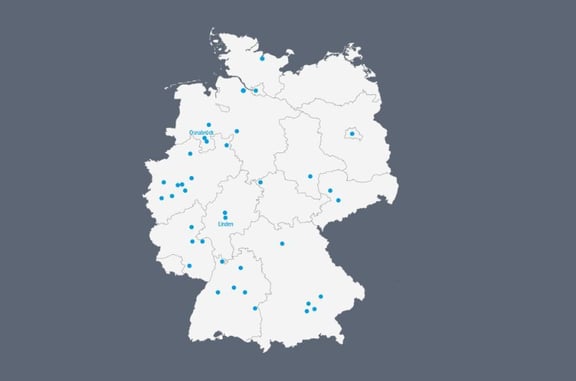
Personal contact for Sytec autoclaves, mediafill and media preparators

The right autoclave for your laboratory

You will receive a non-binding estimate of the effort and costs within 24 hours.

FAQ: Frequently asked questions

An autoclave is a gas-tight pressure vessel that is used for the thermal treatment of materials under overpressure, most commonly for sterilization. The defined temperature, pressure and time parameters allow processes to be carried out safely and reproducibly.

Autoclaves are used in laboratories, medical technology, research and industrial applications. Depending on the area of application, they differ primarily in size and usable volume, process control and design for laboratory or production applications.

Which autoclave design is suitable depends primarily on the application, the space available and the process requirements. Key selection criteria are
  • What is to be sterilized? (e.g. liquids, solids, waste, different loads)
  • What usable volume is required? (batch size, throughput, future requirements)
  • How much space is available in the laboratory? (table-top installation, free-standing unit, integration into existing rooms)
  • What functions and options are required?(e.g. cooling, documentation, special programs)
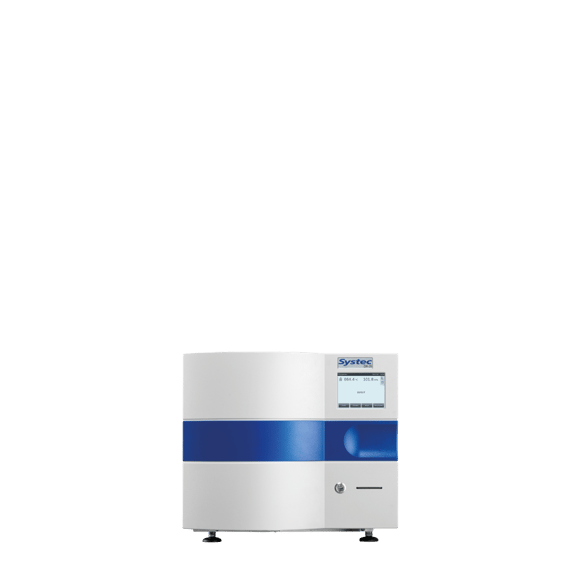
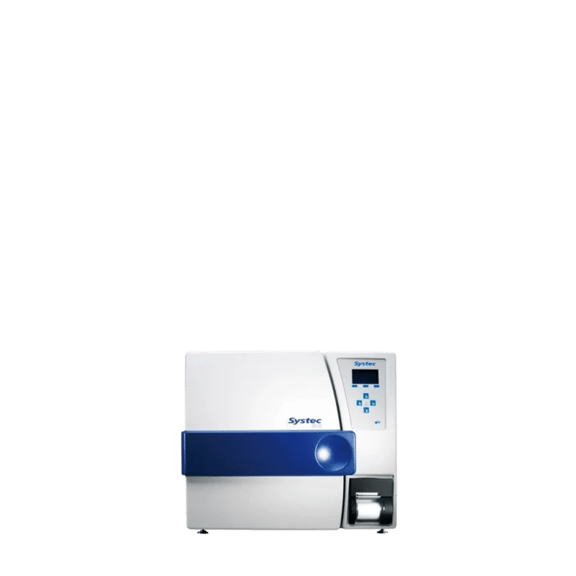
Table-top autoclaves are particularly suitable for smaller volumes, routine applications and laboratories with limited space.
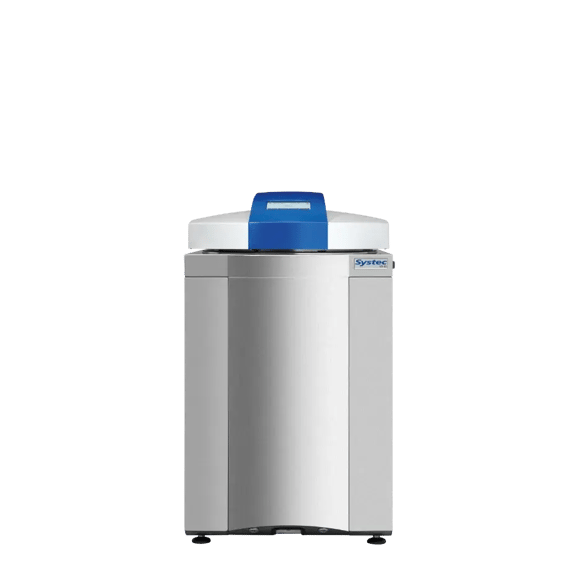
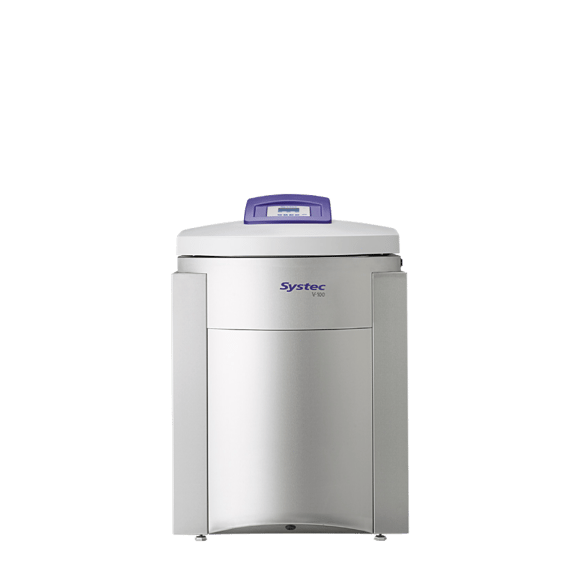
Vertical floor-standing autoclaves, on the other hand, offer larger usable volumes and are designed for higher throughputs or a variety of sterilization tasks.
Depending on the laboratory layout and process logic, horizontal or pass-through autoclaves can also be useful.
Systec autoclaves are available as both table-top and floor-standing units. Thanks to their modular design, the systems can be adapted to different sterilization applications. Even the basic versions of the VE and DE series cover a wide range of sterilization tasks and can be further customized with additional options if required.
The decisive factor is not only the design, but also the fit with everyday laboratory work and the processes that need to be mapped reliably, safely and reproducibly.

Autoclaves are used in very different areas, which is why they are available in different designs, sizes and with different equipment options. Although all autoclaves meet basic safety and performance requirements, they differ significantly in terms of capacity, functionality and level of integration.

  • Large laboratories and production environments generally require autoclaves with higher usable volumes that are suitable for robust continuous operation and offer options for scalable, validatable processes.

  • Research facilities often have special requirements in terms of flexibility, program diversity and the precise mapping of individual sterilization processes.

  • Smaller or universally operating laboratories benefit from space-saving systems, simple operation and versatile basic functions.

Regardless of the area of application, a well-founded needs analysis is always the first step. Not only current but also future requirements should be taken into account. Important criteria include

  • spatial and ergonomic conditions

  • economic efficiency in everyday laboratory work

  • safe, precise, reproducible and validatable sterilization

  • sensible options for adaptation to specific applications.

As a manufacturer of autoclaves, we support you in selecting a system that is technically suitable and can be integrated into your work processes in the long term.

Contact us - together we will find the right solution for your area and your requirements.

Correct sterilization begins with the clear classification of the sterilization material. This is because liquids, solids, waste or biologically hazardous substances all place different demands on process control, ventilation, cooling and drying. It is crucial that the temperature, pressure and time are precisely matched to the material and that the process is reproducible.

The following applies in principle:

  • Liquids (e.g. culture and nutrient media) require uniform temperature distribution and controlled re-cooling to prevent boiling over or loss of liquid.

  • Solids such as glassware, instruments or textiles must be completely deaerated and dried efficiently.

  • Waste is often sterilized in destruction bags or bottles and requires safe steam penetration.

  • Biologically hazardous substances require additional safety measures, such as exhaust air filtration, to protect people and the environment.

Modern autoclaves can be equipped with modular options so that the sterilization process can be specifically optimized for the respective application. This means that only what is necessary for the specific sterilization process is added.

You can find more details on the individual processes in our application overview for autoclaves.

Systec Connect is a browser-based monitoring and documentation platform for our autoclaves. It bundles all relevant process information centrally and makes the status of multiple devices live and clearly visible, eliminating the need for inspections at the autoclave.

Authorized users can use the browser (optionally also via app) to view the program status, runtime, messages and errors, among other things. Colored status displays facilitate quick classification.

The solution is easy to integrate, modularly expandable and designed to increase transparency and efficiency in autoclave operation - especially where several devices or users are in use.

Find out more about Systec Connect.